What are Woods, Really, Henry?
Updated: Mar 24
Mid-Life Questions and Walden
By Brian Privett.

"[Walden] is not the best book I ever encountered, perhaps, but it is for me the handiest, and I keep it around me in much the same way as one carries a handkerchief - for relief in moments of defluxion or despair." ~ E. B. White
"Sometimes I want to leave society, live in the woods, and contemplate existence. But I know that would be Thoreauing away my life." ~ Unknown
I have lost count of the number of times I have read Henry David Thoreu's Walden. I still have my first copy that I picked up when I was 16 from Joseph-Beth, back when it was on the far end of Lexington Green and had tons of books and very little socks, purses, and soap. I have carried this copy of Walden, with its Introduction from Joyce Carol Oates that I have never read, to college and apartments and homes and more homes, and every time I see it I want to pick it up again.
In my fandom, I have visited Walden Pond twice, both times along with my friend Donavan, who has more than likely read the book as much as me, the first visit being a kind of pilgrimage for two 19 year old boys on a road trip with only camping gear and a cooler full of food that had to be kept on ice. The second was in a VW Microbus with friends Rhoder and Shandendoah, but that's a story for another day.
Some of the lines of Walden have etched themselves into my skin deeper than a tattoo - "The mass of men lead lives of quiet desperation" and his version of Whitman's (OK, and Robin Williams' too) barbaric yawp: "I wanted to live deep and suck out all the marrow of life."
And: "if one advances confidently in the direction of his dreams, and endeavors to live the life which he has imagined, he will meet with success unexpected in common hours."
Of course, there's most famous passage: "I went to the woods because I wished to live deliberately, to front only the essential facts of life, and see if I could not learn what it had to teach, and not, when I came to die, discover that I had not lived."
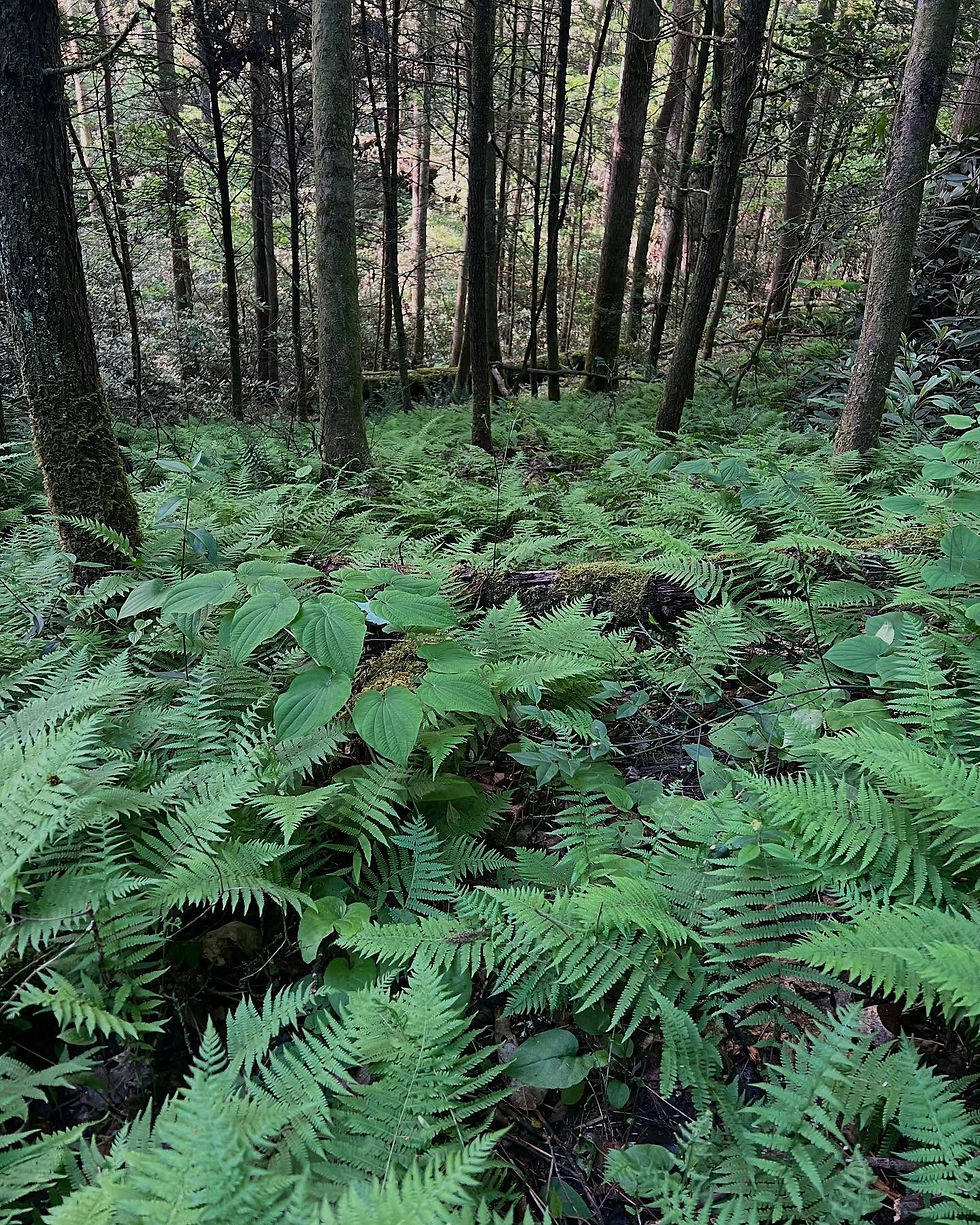
I've been thinking about this last passage a lot this year as I've spent a great deal of time out in the woods, in the Red River Gorge, hiking almost every weekend.
This year I've hiked all of the official trails and some of the unofficial user trails of the Gorge. It's an easy area for me to get to in my truck, within an hour, even though I complain sometimes about the barrenness of my part of Kentucky that makes me jump in a car to go out into the woods. Yes, horse farms are beautiful to look at, but the owners won't let me trek through them to go eat my lunch by a creek.
At first, the Gorge seemed huge, boundless, a dangerous place where people reasonably and regularly get lost. It seemed like an unending place to explore and leave civilization behind. Now that I know the terrain and all the roads and trails, it sometimes just seems like a rather large park. There's shops and restaurants and ATV rental places. It is really crowded every weekend of the summer with all kinds of folks from Ohio. And really, it's geographically not that big. You can loop around the whole area from Nada Tunnel back to Slade in only about 20 miles. The Rough Trail that crosses the area is only 8 miles. I now think when people get lost there, they probably should have just picked a direction and kept walking straight for a bit. You'll run into a road eventually. Take some water. Geez.
Since the Gorge shrunk for me over this year, I started to wonder if it was wild or secluded enough, if the constant visitors mean that it is less woods and more park, and what are woods, really? Is a Walden experience possible there?
The Walden ideal of the woods has become so idealized, so romanticized, so connected with nature and living in it, it has become an American synonym for wild, untamed places. We're wrong though.
There's a famous New Yorker article from 2015 by Kathryn Schulz called "Why Do We Love Henry David Thoreau?" that is a pretty good takedown of the loveable little civil disobeyer and pond resident. The article is excellent, but I cringe at the truth of it because it is so harsh and maybe too much truth about one of my favorite thinkers and doers. Like a music theorist saying that AC/DC's music is too simple and repetitive, Schulz sees only the facts, not the heart. Taken as a whole, the emotion, the power, the rebelliousness of it all, Henry David Thoreau, almost as much as Bon Scott and Angus Young, absolutely rocks. They would definitely salute you, Henry.
Back to the issue at hand, the biggest, and maybe most important, truth from the article is that Thoreau did not live in isolation. Walden Pond was only 1.5 miles away from the center of Concord, Massachusetts, a 30 minute walk to his friend Ralph Waldo Emerson's house. In fact, Emerson owned the land where Thoreau built his house in 1845. There was then, and still is, a railroad track touching the far end of Walden Pond. It was very close to what is now Highway 2, which still runs by there today. Thoreau visited friends constantly and had parties and visitors at his house. He was no grizzled mountain man, he was a guy living in a tiny home in the suburbs.
Here's the point the mass of men miss about Thoreau. When he said he wanted to live deliberately, he meant where every action he had gave meaning. He was a minimalist. He built a house only to the specifications necessary for his shelter. He grew only what he could eat or maybe enough to sell so he could have some more necessities. When he "went to the woods" it was to provide filter, because he did not want to live in solitude, he wanted it to be more difficult for silly people to talk to him, while allowing him to access the people that meant something to him. He wanted every moment of his life to matter.
So why am I going to the woods? Is the Red River Gorge the woods? Is it a forest? Maybe it's a park. I haven't defined it yet, but as I have experienced three seasons in the Gorge this year so far, the definition keeps changing for me. I've seen snow on the cliffs, spring ephemeral flowers, blooming mountain laurel, then rhododendron. I'm on my second pair of hiking boots which I've soaked in creeks, muddied in bogs, and slipped on rocks. I've seen newts and lizards and weird bugs and snakes.
There's something that, despite the crowds some days on the trails, keeps drawing me back. It might just be the short distance from my house. It is definitely a calmness that hits my brain when I get right about mile 5 on a longer hike. It might just be being faced with witnessing the overlaying cycles of life, death, and rebirth in the Gorge, in nature, in the woods. Whatever takes me back, I'm still naming it.
When Thoreau left Walden Pond, he said: "I left the woods for as good a reason as I went there. Perhaps it seemed to me that I had several more lives to live, and could not spare any more time for that one."
I still have time to spare for the Gorge, I think, regardless of what it is.
Brian Privett is a Kentuckian who hikes. He now has to use reading glasses to read Walden.


Comments